


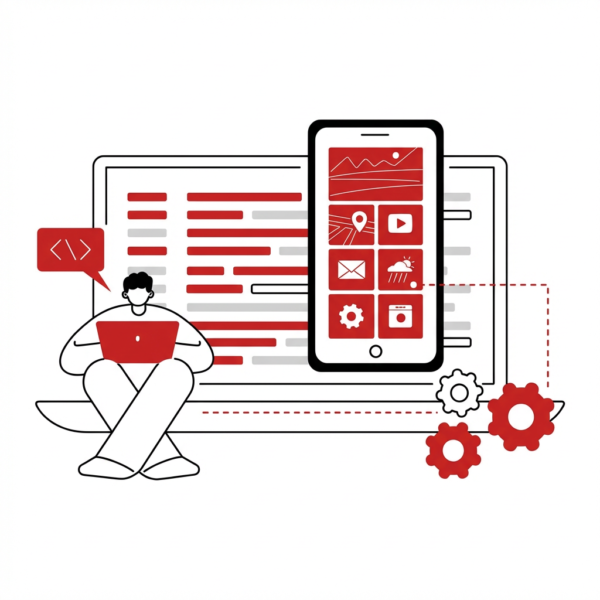
Website Integration with Mobile Applications: A Key to Reaching the Modern Audience
The integration of websites with mobile applications has become a fundamental element for any successful digital project, especially with the increasing reliance on smartphones for accessing news and services on a daily basis in cities such as Riyadh, Jeddah, Dammam, and Makkah. This integration does not simply mean having both a website and an app; it refers to building a unified digital system that connects data and user experience seamlessly, so that the user feels they are interacting with a single platform regardless of the device used.
With the rapid evolution of digital user behavior, relying on a website alone is no longer sufficient, as today’s audience expects speed, personalization, and instant, frictionless experiences.
1. Unified User Experience Across All Devices
When a user moves between a website and a mobile application without noticing differences in design, content, or navigation, they feel more trust and comfort. This type of integration significantly reduces user drop-off during platform switching and increases time spent within the platform—an important factor for improving engagement and boosting search engine rankings.
A consistent visual identity and smooth navigation also enhance brand perception, making it appear more professional and reliable in the eyes of users.
2. Expanding Reach in Local Markets
In Saudi Arabia, user behavior varies from one city to another. Users in Riyadh may prefer fast mobile applications, while others in different cities may rely more on web browsers.
A fully integrated system ensures that content reaches all audience segments without technical barriers or inconsistencies in experience. This naturally expands the user base and increases exposure across cities such as Jeddah, Makkah, Dammam, Madinah, and Taif.
3. Improving Content Interaction Speed
Applications connected to websites enable push notifications, which is a crucial feature in the news and services sector. It allows updates to reach users within seconds instead of waiting for them to manually visit the website.
This capability not only increases engagement rates but also builds a habit of continuous usage, encouraging users to return more frequently. As a result, the value of the content platform itself increases significantly.
4. Centralized Content Management
Proper integration allows content to be managed from a single dashboard, enabling news to be published simultaneously on both the website and the mobile application. This reduces human errors and increases operational efficiency.
Centralized management also simplifies data updates, news corrections, and marketing campaign management in a unified way, instead of repeating tasks across multiple separate systems. This saves significant time and effort for teams and improves workflow productivity.
5. Supporting Growth and Digital Transformation
Organizations that rely on this level of integration are more capable of scaling, whether within Saudi Arabia or in other markets, because they have a flexible and scalable technical infrastructure.
Moreover, this growth is not random; it is driven by accurate user behavior data, which helps make smarter and more effective marketing and development decisions.
6. Improving Performance and Data Analytics
One of the most important benefits of integrating websites and mobile applications is the ability to collect unified user data, such as browsing behavior, time spent on the platform, and preferred content types.
This data enables better content optimization, personalized user experiences, and higher conversion rates across news, service, or commercial platforms.
7. Strengthening Competition in the Digital Market
In today’s highly competitive Saudi market, having either a website or an application is no longer enough. The real advantage comes from integrating both systems into a unified digital ecosystem.
Platforms that fail to implement this integration often suffer from lower engagement and a gradual decline in user base over time.
Finally, website and mobile application integration is no longer an optional feature—it has become a core requirement for competing in the modern digital landscape. Any news or service-based project that does not implement this integration will struggle to retain its audience in the long term, especially given the rapid evolution of user behavior in the Kingdom of Saudi Arabia.