



E-Commerce is currently the fastest-growing and most prominent sector in global markets. Since the early 1990s, the concept of E-commerce has spread, offering numerous advantages for business owners and major companies who want to showcase their products for sale or purchase across countries online, saving both time and money.
However, E-commerce is not limited to buying and selling only! This is what we will discuss in this article. We will explain the concept of E-commerce, its importance, and its types. We will also explore the advantages and disadvantages of E-commerce and highlight the best digital marketing companies in Saudi Arabia that can help you better understand the E-commerce market and benefit from it.
What is E-Commerce?
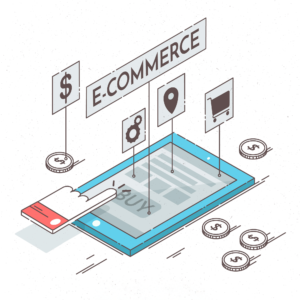
The concept of E-commerce refers to a system for buying and selling goods, services, and products using the internet, along with the transfer of money and data to complete these transactions. E-commerce is often used to describe the sale of products and goods online, but it can also refer to any type of commercial transaction conducted via the internet, making it easier for customers to save time and money. E-commerce supports sales operations and customer service. There are many websites operating in the E-commerce sector, the most famous globally being Amazon, Souq.com, Jumia, and eBay, among other successful and profitable companies, which we will discuss further in this article.
The Future of E-Commerce
The future of E-commerce promises many exciting opportunities and developments. This is largely due to the continuous and rapid advancement of technology, the widespread availability of the internet, and the expansion of the digital world in general. Today, creating an E-commerce website has become an integral part of daily life for both consumers and businesses. The reliance on E-commerce is expected to grow even more in the coming years thanks to innovations in artificial intelligence, big data analytics, and advanced technologies in buying and selling processes.
These technological developments will enable companies to offer more personalized and engaging shopping experiences for customers, making them more enjoyable and advanced, which enhances customer satisfaction and loyalty. Technologies such as augmented reality (AR) and virtual reality (VR) will create new opportunities for interacting with products in highly innovative ways that were previously impossible. Additionally, the electronic payment sector will experience significant improvements, making online purchases safer, easier, and accessible through multiple digital methods.
In the job market, the importance of E-commerce will continue to create new career opportunities in areas such as digital marketing, website development, customer service, and other digitally delivered services. Skills related to these fields will be increasingly in demand, providing opportunities for professional learning and development.
Overall, the future of E-commerce promises innovative and efficient shopping experiences, supports economic growth, and creates new job opportunities, making it a vital element in the modern business world.
The Importance of E-Commerce
E-commerce holds significant importance for both countries and individuals, including the following aspects:
Improving the Economy
E-commerce contributes to improving the economy through electronic commercial transactions. It can provide opportunities to reach global markets through exports, which helps boost economic growth. The various types of E-commerce play an important role in enhancing economic development.
Creating New Job Opportunities
With the expansion of E-commerce, new job opportunities have emerged in fields such as digital marketing, platform management, data analysis, and customer service. All of these developments open up valuable career opportunities.
Ease of Expansion and Competition
E-commerce allows small and medium-sized enterprises to compete with major brands. By creating an online store, any company can promote its products and reach a wide audience without incurring high costs.
Improving the Consumer Experience
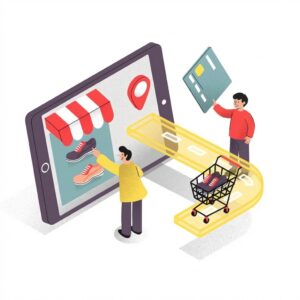
E-commerce enables transactions to be completed faster and more conveniently compared to traditional commerce. Customers can purchase products or services from their homes, saving time and effort, which increases overall customer satisfaction.
Types of E-Commerce
There are various methods and approaches to promote and sell goods and products online. E-commerce can be divided into six main categories:
1- Business to Business (B2B)
The first type of E-commerce is Business to Business (B2B), which involves electronic commercial transactions between one company and another. It relies on marketing relationships between the two companies, such as one company displaying its products to another. They exchange marketing and trade, creating more opportunities for sales through E-commerce.
2- Business to Consumer (B2C)
This type occurs between companies and individual customers and is known as Business to Consumer (B2C). It aligns with the retail segment of E-commerce. B2C is considered one of the easiest and most profitable types of E-commerce and continues to grow due to the increasing use of the internet worldwide. It covers a wide range of consumer goods such as computers, software, books, shoes, cars, food products, and other electronics.
3- Consumer to Consumer (C2C)
Consumer to Consumer (C2C) E-commerce covers all electronic transactions of goods and services between consumers. These transactions are usually conducted via a third-party platform that facilitates the exchange. For example, you can sell your used furniture on eBay or Amazon to another consumer.
4- Consumer to Business (C2B)
In this model, consumers sell their products or services to companies seeking them. Known as Consumer to Business (C2B), this type is popular for freelance work and small projects. Examples include designers selling logos and designs to companies or photographers providing royalty-free images on platforms like iStockphoto or Shutterstock.
5- Business to Administration (B2A)
B2A E-commerce involves online transactions between companies and government entities. It includes a wide range of services such as financial services, social security, labor, documents, and legal records. These services have significantly expanded in recent years with investments in e-government initiatives.
6- Consumer to Administration (C2A)
C2A E-commerce covers all online transactions between individuals and government entities. Examples include education, information distribution, remote learning, social security services, taxes, and electronic payment of health services.
Note: Both B2A and C2A models rely heavily on efficiency and ease of use of government services, supported by information and communication technology.
Advantages of E-Commerce
Key advantages of E-commerce include:
-
Global market access without large financial investments.
-
Easy access to information about products and the ability to compare with other products.
-
Brings suppliers closer to their customers, increasing productivity and competitiveness.
-
More efficient support before and after sales across various types of E-commerce.
-
Saves time and effort for consumers, allowing for easy and successful online transactions.
Disadvantages of E-Commerce
The main disadvantages of E-commerce include:
-
Heavy reliance on information and communication technology.
-
Some websites lack complete security for data confidentiality during online transactions.